
The next ten years will bring more change to our careers than the last hundred combined. When AI agents begin working on your behalf, what they know about you becomes the most valuable thing you own.
Most of us have been taught to describe a career in the same way: where we studied, where we worked, what title we held, and what came next. That is what a résumé records. It worked when careers changed slowly. It is not enough now.
We are living through a pivotal moment in working life. The transition into the AI economy is not something arriving on the horizon. We are already inside it, and it is moving considerably faster than the language we use to describe our own careers.
Nearly all of us are about to be working alongside AI agents. Managing them, directing them, deciding what to hand over and what to keep for ourselves. And then something further: having agents work on our behalf, preparing, researching and representing what we know when we are not in the room.
Companies are already building teams of AI agents to advance their organizations. Individuals will have the same working for their careers. I think this decade ends there, and I think it arrives sooner than most people expect.
Which raises the question this article is about. When an agent works on your behalf, what does it actually know about you?
The advantage will belong to professionals whose agents have something real to work from. An agent with no record of your judgment is a faster route to generic advice.
The most valuable professional knowledge was never written down.
Some of it is captured. Portfolios, performance reviews, communities of practice and knowledge management systems all hold pieces of it. Almost none of it belongs to the person who built it, in a form they can carry anywhere.
What is a living career system?
A living career system is a record of professional knowledge that develops continuously as a person works, rather than a static summary written once and revised during a job search. It captures the judgment, patterns and expertise a career produces, keeps that knowledge connected to the individual across roles and industries, and makes it usable by AI agents working on that person’s behalf. A résumé preserves a history. A living system grows an asset.
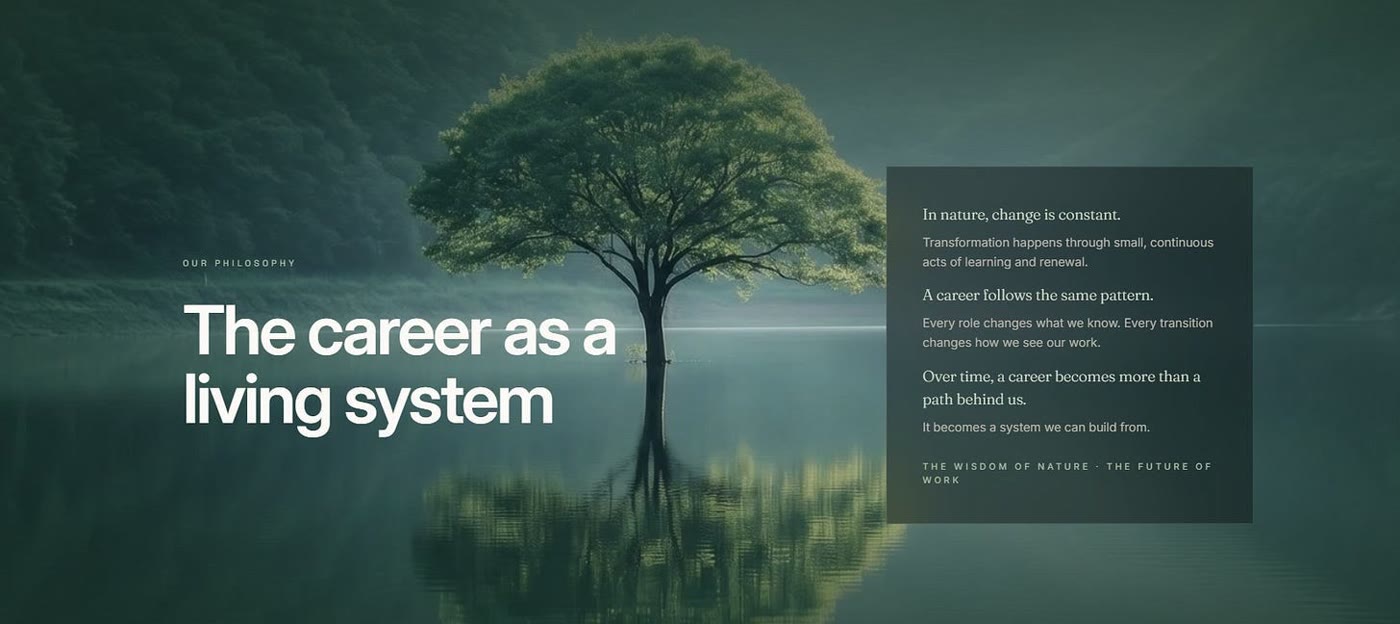
In nature, change is constant. Renewal happens through small, continuous acts of learning. A career follows the same pattern. Every role changes what we know. Every transition changes how we see our work. Over time a career becomes more than a path behind us. It becomes a system we can build from.
That is the shift this decade will be remembered for, and almost none of our current instruments were designed for it.
Why was the most valuable professional knowledge never written down?
Because the most valuable part of what a professional knows is tacit knowledge: the practical understanding a person develops through years of work and lived experience. Tacit knowledge resists compression. It shows up as recognizing a failing process before the data confirms it, knowing which approach will not survive contact with a particular room, and reading a situation correctly because you have lived through three like it. None of that fits a bullet point, so historically none of it was recorded anywhere.
I know this particularly well from operations. Two decades of running complex operations taught me that organizations depend every day on knowledge no system holds. An experienced leader senses a process beginning to fail before it appears in a report. They know the difference between a temporary disruption and something structural. They understand that a decision improving one part of an operation can create a problem in another.
That knowledge came from doing the work, getting things wrong, correcting course, and seeing similar situations more than once. It keeps its value when the industry changes.
Tools for holding it have existed for a long time. E-portfolios, reflective practice, knowledge management systems, case records. Almost none of them were built for the individual to own, carry and use across a whole working life.
Much of our knowledge has remained invisible.
What is the difference between a skill and professional knowledge?
A skill describes what a person can do. Professional knowledge describes everything surrounding it: the context in which they learned it, the judgment that determines when to apply it, and the experience that shapes how they read a situation. Knowing how to run a project is a skill. Knowing what to do when the scope changes, a key person resigns and the original plan stops working comes from somewhere else. Two people can hold the same title for the same years and develop entirely different professional knowledge.
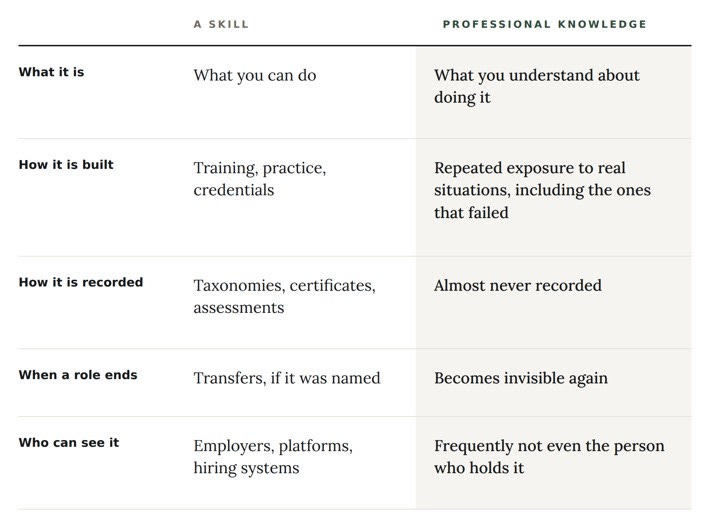
Skills-first hiring has been one of the better developments in workforce practice. Looking directly at what people can do opens opportunities that credential-based hiring missed for decades. It remains a real advance and it should continue.
It also stops one level short. Experience puts context around capability. It teaches a person when to apply what they know, when to hold back, and when the situation in front of them differs enough that the usual answer will fail. That layer becomes more valuable as a career develops, and we have built almost nowhere to keep it.
From knowledge worker to knowledge owner
For decades we have called professionals knowledge workers because what they know is central to the value they create. The term describes the work and says nothing about the ownership.
From knowledge worker to knowledge owner.
Knowledge ownership does not mean holding an employer’s information. Confidential material, company data and intellectual property stay exactly where they belong. It means a professional having a genuine, developing, personally held understanding of what their own working life has produced, in a form that travels with them and grows as they do.
Ask an experienced person what they have learned over ten years and the first answer sounds like a résumé. Roles, projects, promotions. Stay in the conversation and something else surfaces. The problems colleagues repeatedly bring to them. The moments their judgment changed an outcome. The patterns they now see years earlier than they once did. The mistakes that permanently altered how they work.
That is the asset. For most people it has never been written down, which means that every time their work changes they rebuild their professional identity from memory, under time pressure, for an audience that has never seen them work.
Why should professionals have their own AI agents?
Because intelligence is already being built about professionals, and the professional is rarely the one holding it. Employers run talent platforms and assessments. Recruiters run matching tools. Professional platforms infer skills, relationships and opportunities from enormous datasets. Those systems are improving quickly. The individual, meanwhile, still has a résumé. Personal AI agents close that asymmetry by working from knowledge the professional owns rather than data collected about them.
This is the imbalance that led me to build Career Ventures.
AI can remember a conversation. It does not know what twenty years of experience have taught you.
Ask a general model about your career and it answers from the average of everyone’s. Intelligence grounded in your own professional knowledge can do something different in kind: it knows what you have actually learned, so it can speak to what you are genuinely ready for.
The direction of the relationship is the entire point. Intelligence that begins with the individual’s own professional knowledge and works on their behalf.
The boundary between personal knowledge and employer information has to stay clear. Privacy matters and so does accuracy. Any system built to support a career should sharpen a person’s judgment rather than quietly deciding for them. These are design problems, and design problems get solved by people who take them seriously early.
What does this mean for the Career Economy?
It means the starting point of every career transition changes. The AI economy is the context all of us are moving into. The Career Economy is what gets built inside it once professional knowledge becomes something a person owns, develops and puts to work. One is the weather. The other is what we choose to construct in it.
None of this removes responsibility from employers, educators, workforce organizations or government. People cannot solve structural problems in labor markets through better self-awareness. A professional cannot create an internal opportunity an employer never opened. Someone cannot train for a new field if the learning is financially or practically out of reach. Career agency should never become another way of telling people to adapt faster. Institutions still have to build real pathways, invest in learning that matters, and think carefully about how technology decisions land on the people doing the work.
What I am arguing for sits alongside all of that and changes where the process begins. When a person enters those systems already understanding what their work has produced, reskilling stops being gap-filling. A career change stops being a reset. New learning gets built on top of something substantial.
For an experienced professional that difference is worth an enormous amount, and at the scale of an economy it is worth more than almost anything else we are currently funding.
A career should not have to be reconstructed every time it changes
For years the central question in workforce development has been how to prepare people for the work that is coming. It is the right question and we should keep asking it.
#### There is another that belongs beside it: how do we build careers that keep growing instead of restarting?
AI will keep changing parts of our work. Some skills will become less valuable, new ones will emerge, and most of us will keep learning throughout our careers.
What should not disappear every time a role changes is everything we have learned along the way.
For most of our working lives, that knowledge has lived largely in our heads. We now have the ability to capture more of it, keep it connected to us, and eventually give our own AI agents something meaningful to work from.
Key Takeaways:
- A career produces professional knowledge that a résumé was never designed to record.
- Personal AI agents become far more useful when they can work from a living record of what the individual has actually learned.
- Career agency in the AI economy begins with making more of that knowledge visible and keeping it connected to the person who built it.